
Daily cycling in a Polish city involves a different set of gear decisions than weekend riding. The commute doesn't allow for carrying a full kit change or spending time adjusting complex equipment at the roadside. What works is gear that requires minimal setup, stays in place over rough urban surfaces, and holds up to daily use across a full weather year — from April drizzle to October fog to the occasional frozen morning in November when riders who haven't yet stored the bike face 200 metres of black ice near a tram track.
Helmets: Standards and Practical Differences
Helmet certification in Poland falls under EU standard EN 1078, which covers bicycles and skateboards. All helmets sold legally in the EU market must carry this certification. The standard defines minimum impact absorption requirements, retention system strength, and peripheral vision requirements — but it sets a floor, not a ceiling. Helmets meeting only the EN 1078 minimum are not inherently worse-performing in everyday urban falls than premium models, but the latter often include MIPS (Multi-directional Impact Protection System) or equivalent rotational force management systems that reduce brain movement during oblique impacts, which are the most common type in real cycling accidents.
For urban commuting at speeds of 15–25 km/h — the typical range on city infrastructure — the priority in a helmet is ventilation, weight, and retention system quality rather than aerodynamic performance. Helmets with fewer but larger vents tend to handle Polish autumn rain better than heavily vented road helmets, which channel water directly onto the head in heavy downpours. Brands like Giro, Bontrager, and Kask distribute widely through Polish cycling retailers (Bikestacja, Rowery.pl, and similar chains carry most major lines).
What to look for in a commuter helmet
- EN 1078 certification — mandatory for EU sale
- MIPS or equivalent rotational protection — increasingly standard across mid-range models
- Dial-fit retention system — allows single-hand adjustment while wearing gloves
- Integrated rear light mount — reduces the need for a separate helmet light
- Weight under 280 g for full-day comfort
Lighting: What Polish Law Requires and What Riders Actually Need
Article 50 of the Polish Road Traffic Law (Ustawa Prawo o ruchu drogowym) requires that a bicycle operated after dark display a white or yellow light to the front and a red reflector to the rear. This is the legal minimum. In practice, a powered rear light is essential for riding safely on urban streets where car headlights are the dominant light source and reflectors are easily lost in the visual complexity of city environments.
The most common front light format for commuter use is a USB-rechargeable mount light rated at 400–800 lumens. Below 400 lumens, visibility suffers on unlit paths and in fog. Above 800 lumens, there is a risk of dazzling oncoming cyclists if the light is not angled downward correctly — a particular issue on shared paths. Rear lights in the 50–100 lumen range with a daytime flash mode are visible in daylight conditions and last a full riding season between charges on many models.
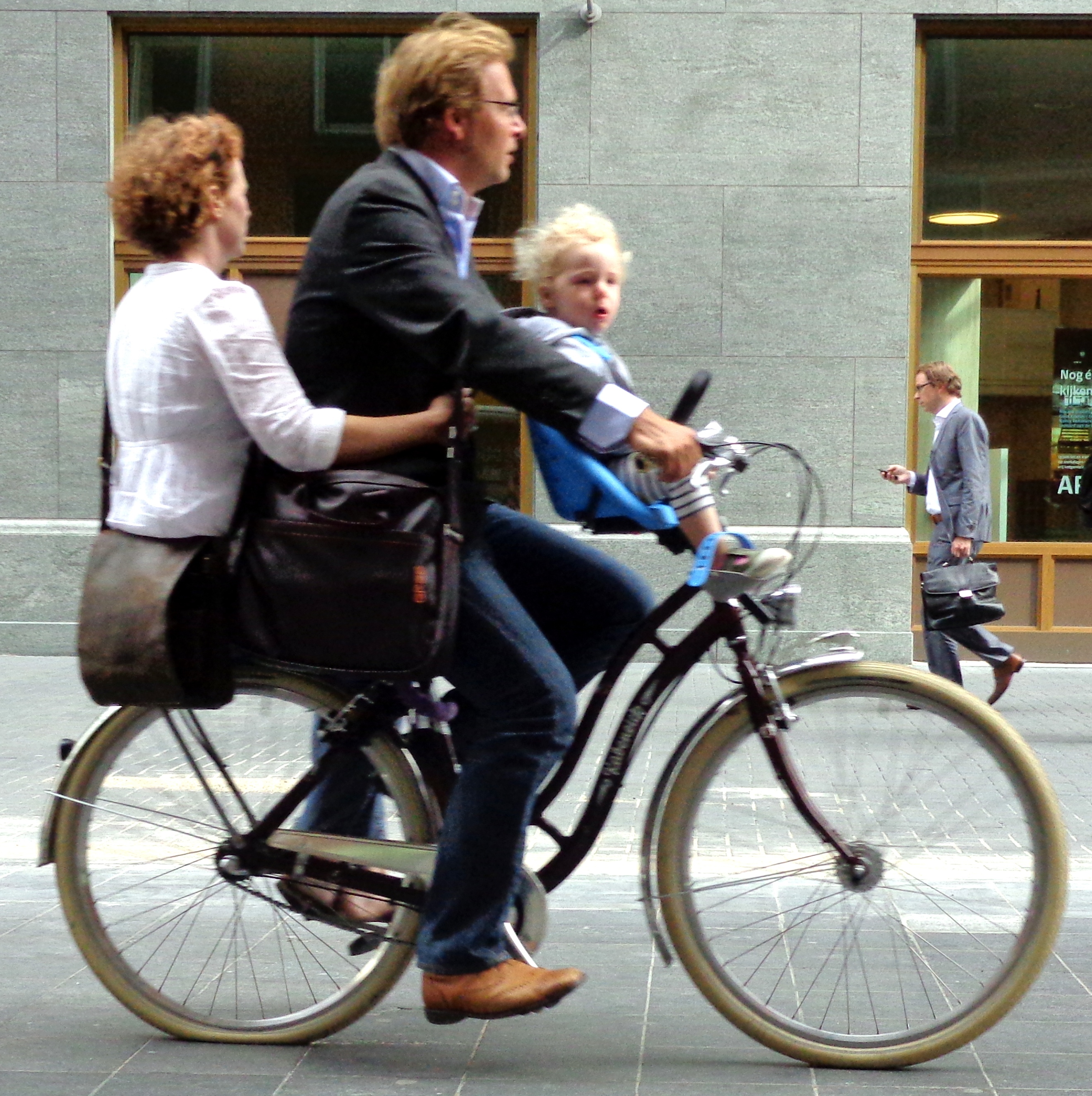
Daily commuter setup — lights, secure load carrying, and appropriate helmet. Photo: Wikimedia Commons / CC BY-SA
Recommended light mounting positions
- Front: handlebar centre or fork leg — handlebar centre is more stable over rough surfaces
- Rear: seatpost mount preferred over seat bag mount (more stable, less vibration-induced flicker)
- Secondary rear: helmet rear light increases visibility height above road level — useful in heavy traffic
Locks: Risk-Proportionate Security
Bicycle theft rates in Warsaw and Kraków are high enough that lock quality directly affects the realistic cost of commuting by bike. A lock rated below Sold Secure Silver (or the equivalent ART 2 rating used in the Netherlands and increasingly referenced by Polish insurers) is inadequate for leaving a bike unattended in a city centre for more than 30 minutes.
The main formats and their trade-offs for urban commuting:
- D-lock (U-lock): Best resistance to leverage and cutting attacks. Abus Granit X-Plus 54 and Kryptonite New York Standard are the two most widely cited models in the commuter cycling community for their resistance ratings. Weight is typically 900 g–1.2 kg — significant for daily carrying.
- Chain lock: More flexible in what it can lock to; heavier than a D-lock at comparable security levels. Pragmata for cities with varied rack types.
- Folding lock: Compromise between portability and security. Abus Bordo Granit line at 85 cm length covers most rack configurations without carrying a chain. Security rating below a comparable D-lock but sufficient for medium-risk locations.
- Cable lock: Not adequate as a primary lock — cables cut in under 15 seconds with bolt cutters. Acceptable as a secondary lock to secure a wheel alongside a D-lock through the frame.
Bags and Load Carrying
How a commuter carries load affects both handling and fatigue over a full season. The options divide into three categories with distinct implications for daily use:
Panniers on a rear rack: The most practical format for carrying 10+ litres daily. Load sits low and does not affect the rider's centre of gravity. The rack requires secure mounting — racks that flex under load cause tyre rub and eventually crack at the eyelets. Ortlieb Back-Roller Classic panniers are the most common high-quality option in Poland; their roll-top waterproof closure means no separate rain cover to manage.
Backpack: No rack required, easier to carry off the bike, but increases upper body sweating in summer and shifts the rider's centre of mass upward, which is noticeable during emergency braking. Acceptable for loads under 7 kg; above that, a rack system is more comfortable for daily use.
Frame bag or saddle bag: Works well for small items — pump, tool kit, spare tube, wallet — without adding the bulk of a full rack setup. Not a replacement for a pannier if the commuter carries a laptop or change of clothes.
Reflective Visibility Beyond Lights
Polish cycling infrastructure includes sections where overhead lighting is absent or insufficient. Reflective details on clothing, bags, and tyres extend visibility significantly beyond what lights alone provide in these areas. Tyre side reflectors (included on tyres like the Schwalbe Marathon line) add a moving visual element that drivers register differently from static reflectors on the frame.
High-visibility vests are required equipment for cyclists in some EU countries but are not legally mandated in Poland. In conditions of reduced visibility — fog, heavy rain, or dusk before lights are effective — a reflective vest worn over regular clothing is one of the lowest-cost interventions with measurable safety impact.
Summary: What a Functional Commuter Setup Requires
- EN 1078 certified helmet with MIPS and a quality retention system
- USB-rechargeable front light (400–800 lm) and powered rear light (50–100 lm)
- D-lock rated Sold Secure Silver or above for primary security
- Rear rack with waterproof panniers for carrying beyond 7 kg
- Full-coverage mudguards to protect drivetrain and rider in wet conditions
- Reflective ankle straps or trouser clips to prevent contact with the chainring
For comparative buying guidance on locks and lights, the Bicycling magazine gear section and the Cycling UK resources publish periodic comparisons with consistent methodology.